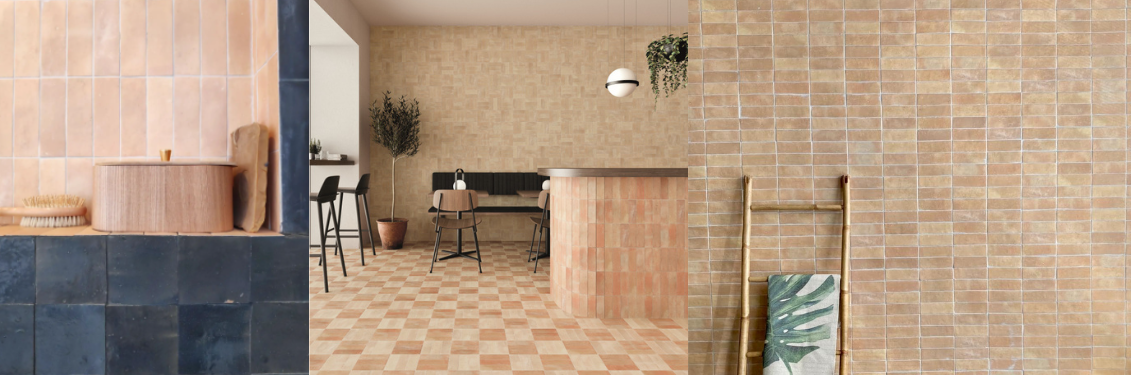
Is Moroccan Naturel suitable for your project?
11 October 2022
Moroccan Platta, Zellige and Bejmat tiles have been made according to the same authentic recipe for centuries. They are formed from clay, dried in the sun, glazed and fired in an olive-pit kiln. This process is carried out by hand, tile by tile.
Over the years, various versions have naturally emerged. The square Zellige is actually more of a Western form; in Morocco, people tend to favour the smaller shapes, or “mosaics”, in different forms and colours. Entire streets are still decorated with these!
The tile we call “Naturel” is actually an unglazed tile. It is literally a slice of clay that has been dried in the sun. In Morocco, the Naturel tile is often used together with the green brick tile, the Bejmat Vert Foncee. The colours really complement each other beautifully!
Since natural shades became completely “on trend” in the Netherlands, the unglazed colour has also attracted attention. Designtegels’ Naturel tile is in demand! But because the tile is unglazed, there are a number of important points you need to know before choosing it:
1. Untreated = susceptible to all stains! The tile is not sealed. The slice of clay absorbs any moisture and dirt it comes into contact with. You cannot remove it afterwards. In Morocco, this is not considered a problem. It further emphasises the natural character. Do you consider this a problem? In that case, we advise against using this tile in your home.
2. Which room are you going to install the tile in? As indicated in point 1, we do not recommend installing the tile in a room where there is a lot of dirt or moisture. Because it is unglazed, the tile is also not waterproof. So do not install it in your shower room!
3. Are you going to install the Naturel tile on the floor? Bejmat and Platta are suitable for this. We do recommend impregnating them. This effectively adds an extra layer over the clay, making it slightly less easy for dirt and grime to penetrate. This can be done with Vlekstop and Tegelolie. Please note: Tegelolie makes the tile appear more yellow, like the colour of oil. Read the steps below to find out how much to apply in each room.
4. Are you going to install Zellige, Bejmat or Platta tiles on the wall? If this is in a place where there is not much dirt, such as a hallway wall or behind the stove, it is enough to treat the tile with Vlekstop alone. For a kitchen splashback or behind the bathroom cabinet, we do recommend using oil as well, although this is not essential.
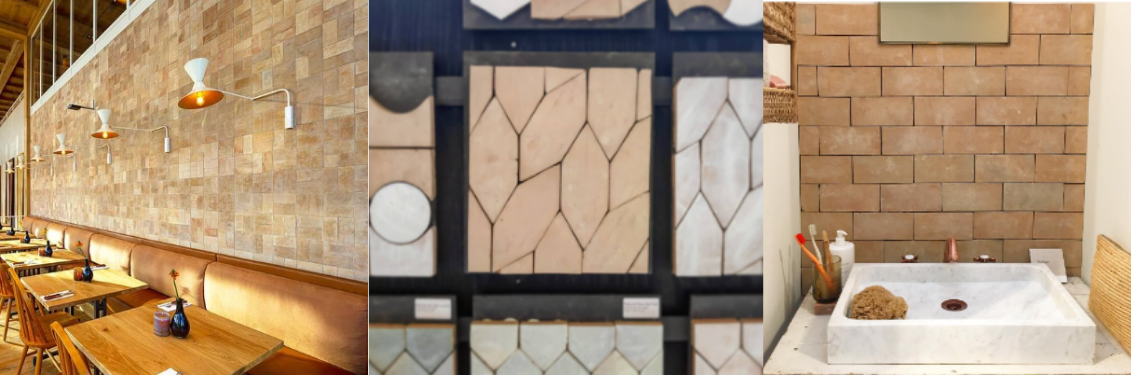
How much impregnating agent do you need to impregnate the Naturel tile?
This is very difficult for us to estimate. Because the tile absorbs so much, it depends on the thickness of the tile and which impregnating agent you use.
For the thick (floor) tiles Bejmat and Platta we recommend 1 litre per 5 m2, per impregnating agent.
The Zellige tiles are thin and therefore absorb less. For these, we recommend 1 litre per 7 m2, per impregnating agent. After installation and before impregnation, always clean the tiles first with Azule cementsluierverwijderaar, so that the white cement haze from the adhesive, grout and excess lime in the tile is removed before impregnation, after which it can no longer be removed. Do this with a scouring pad; hard scrubbing is sometimes necessary!
Always ask us for advice. Since every project, room and tile is different, we always try to find a suitable solution together.
An alternative to the Naturel tile is the Piedra Biscuit or Tan tile. This has the look of the Moroccan Naturel tile, but is ceramic and not susceptible to stains or dirt.